
The Coming XCP Supply Crunch EXPOSED

Disclosure: I own a lot of XCP. This is my research & analysis, not investment advice.
Most people don't know what XCP is. Recently, I shared The Case for Counterparty. That post was nostalgic and cultural. This post is structural: where are the coins, how often do they move, and why the low supply (2.59M) and even lower float can be both a problem and opportunity.
Because the market doesn't trade the full ledger supply. It trades the float—the set of coins that can plausibly show up as sell-side liquidity when bids appear.
And XCP's price-setting float is tiny.
Why I Wrote This
I've been around Counterparty since 2015. I've watched XCP be early, be right, be ignored—and then suddenly be relevant again. Usually faster than people expect, and always with liquidity thinner than the narrative implies.
Right now I'm building a new Counterparty wallet extension, which means I spend a lot of time thinking about onboarding.

There are great features offered by Counterparty that require having the native token XCP, just like how BTC, ETH, or SOL are used to pay tx fees on their networks.
But it's way harder to buy XCP than it is BTC, ETH, or SOL. Not impossible, just hard.
The XCP Problem
If XCP were available on popular exchanges and swap services then needing it wouldn't be a hurdle. It would be a normal network-token requirement.
But today, XCP is not on major venues. And it's not because nobody ever listed it.
It got listed and did $360 million in volume during the exchange era (2017–2019).
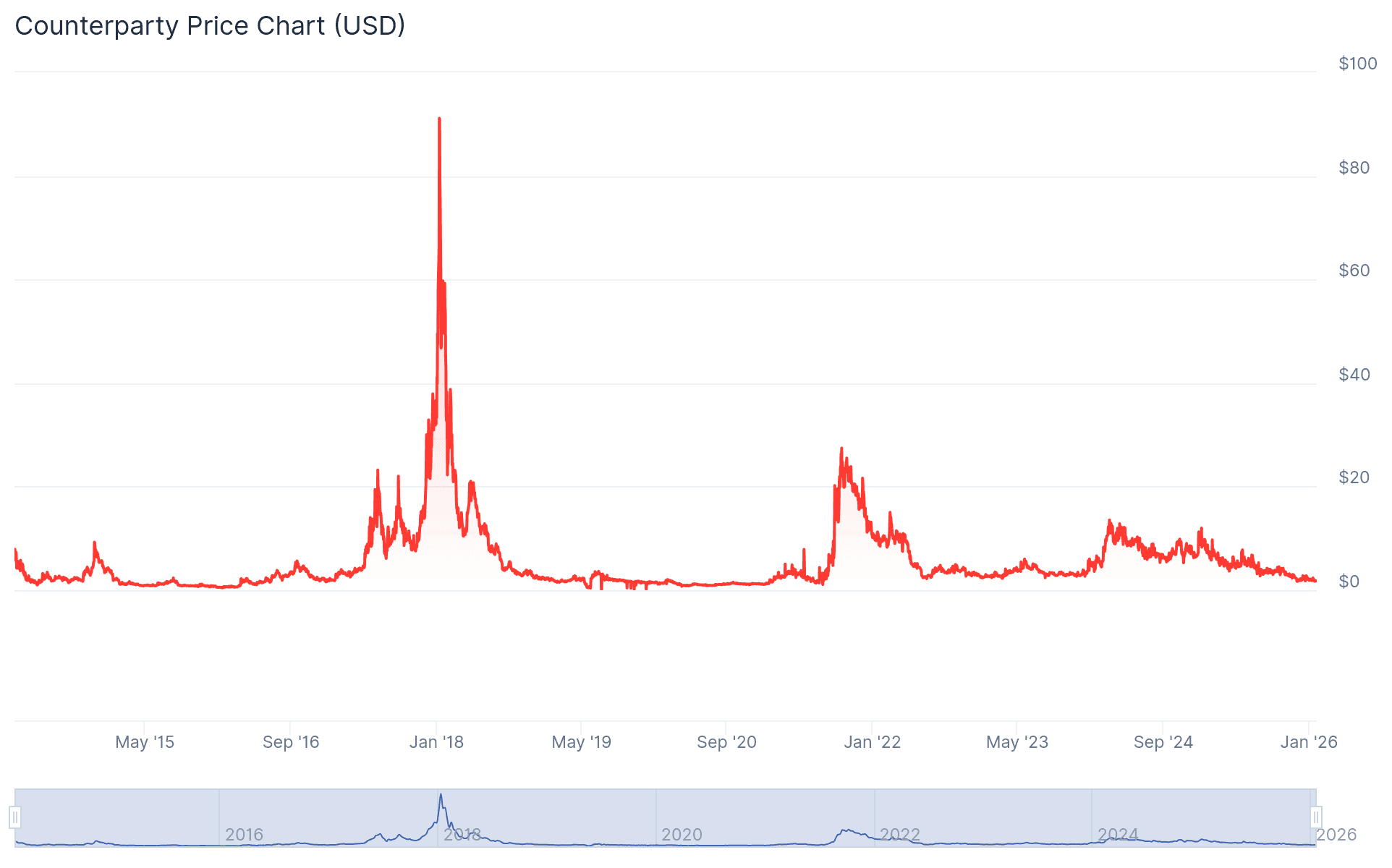
One parabolic run up to $100 XCP in 2018 with several other notable movements shown.
Then the venues that mattered either delisted it or removed support — and a meaningful amount of XCP never made it back to the market.
Stranded-Supply
-
BTER was hacked in February 2015 and never fully recovered — stranding XCP holders.
-
Poloniex delisted XCP in May 2019 — the market first, then withdrawals were disabled.
-
Bittrex removed XCP wallet support in December 2019 — and later filed for bankruptcy.
Today, we still see those balances sitting in known exchange wallets, not moving for years.
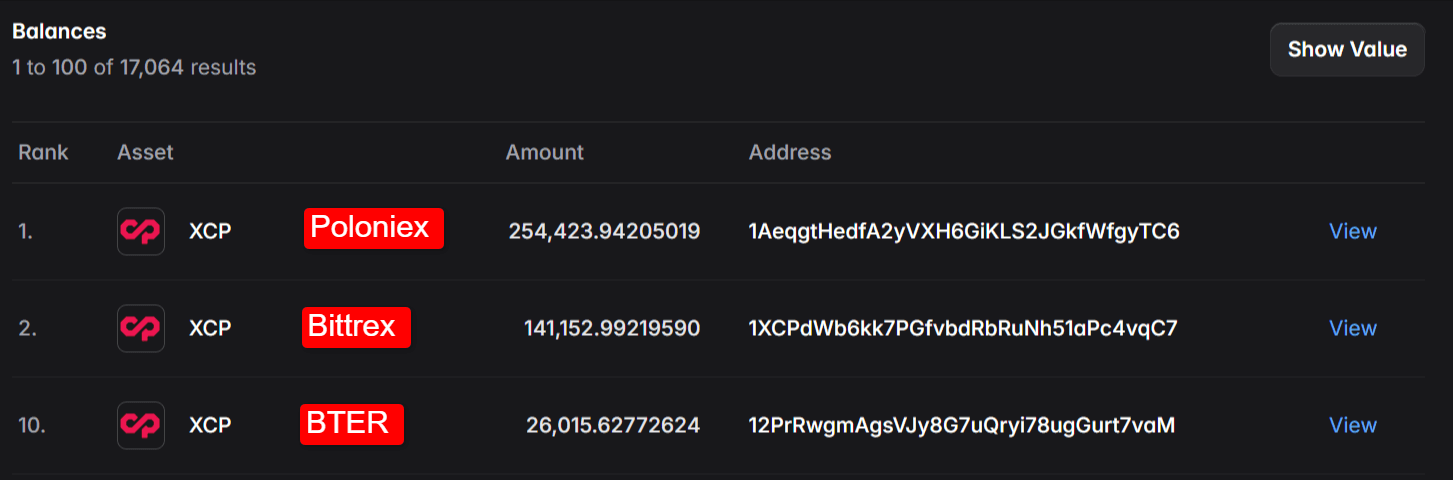
Those aren't "long-term holders" in the normal sense — those are trapped balances.
What That Means
When you strand supply on dead/delisted venues, you do two things at once:
- You make the asset harder to buy (fewer ramps).
- You reduce the circulating supply that can respond to demand (less liquidity).
That’s a headwind for adoption.
But it also has a market-structure consequence that most people miss:
You can't "sell pressure" the market with coins you can't move.
Stranded supply reduces access and reduces the set of coins that can show up as sell-side liquidity. Dormancy does the same thing behaviorally.
If those balances don't have a withdrawal path, they don't participate in price discovery. They're out of the game.
I'm reminded of something Trace Mayer would say: that prices are set at the margin. (Counterparty was under development in 2013 when the above interview took place.)
And that’s before we even talk about dormancy.
Dormant XCP
Trapped supply is one thing. But even the XCP that can move... mostly doesn't.

Where the supply rests
Only 7% of supply sits on active exchanges. The rest is either trapped, locked, or in holder wallets—and those wallets are mostly asleep.
| Category | XCP | % |
|---|---|---|
| Holder wallets (off exchanges) | ~1.95M | 75% |
| Trapped on defunct exchanges | ~422K | 16% |
| Active exchanges (Zaif, Dex-Trade) | ~174K | 7% |
| Protocol escrow | ~42K | 2% |
A Note on Zaif
Zaif is technically an active exchange—Japan's regulator formally recognized XCP in 2017. But in practice, it's a thin order book with minimal volume. The ~132K XCP deposited there mostly sits dormant. And this CEX requires trades be settled in JPY.
As I'm writing this, Zaif reports $275k volume in the last 24 hours and only $4 of it was XCP.
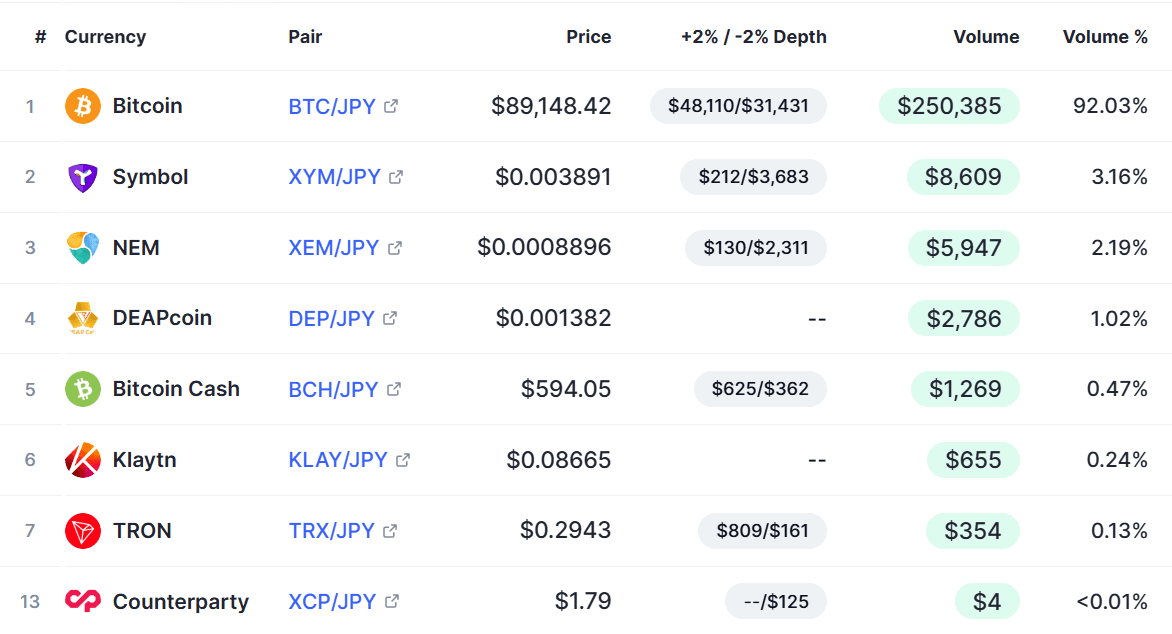
The problem: Zaif's order book is what CoinMarketCap uses for XCP pricing. So the "market price" you see is set by a low-liquidity venue that doesn't reflect real demand.
Why Float Matters
XCP's protocol supply is knowable. The float is behavioral. A coin can exist on-chain and still not be part of the market—because the holder doesn't sell, can't sell, or isn't even around.
- Headline supply tells you how scarce the asset is in theory.
- Float tells you how violent price discovery can be in practice.
Here's a microstructure snapshot: if you market-bought every visible ask order across all venues right now, you'd absorb roughly 42,000 XCP—about 1.6% of supply.
When net demand hits a thin tape, price doesn't "trend" upward. It gaps. It teleports.

The 2021 NFT Bubble
Here's what happened last time attention returned:
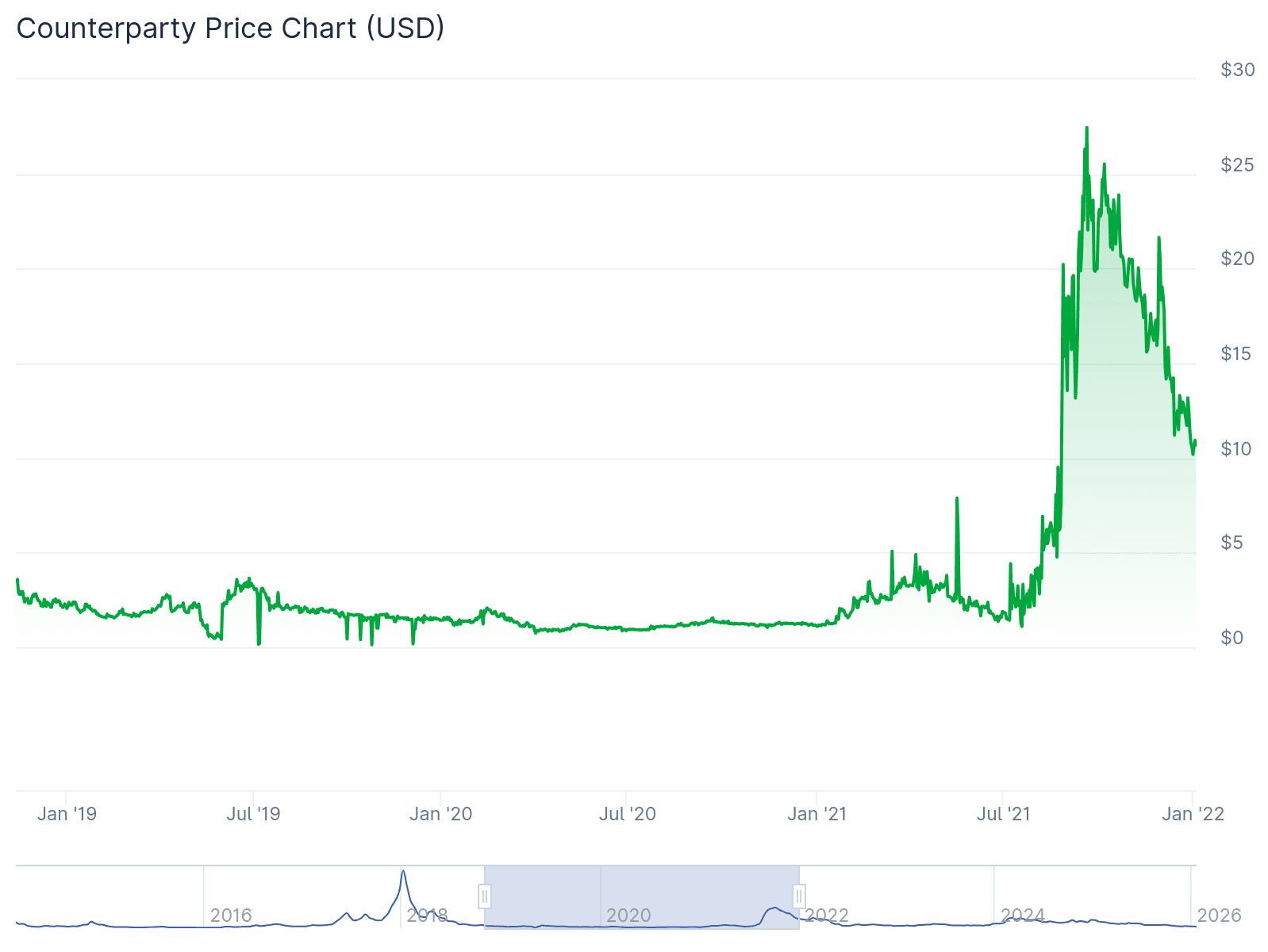
- 2019–2020 were flat. XCP drifted between $1–2 with minimal volume. Poloniex and Bittrex had already delisted.
- Early 2021, the NFT bubble hit. Rare Pepes and early crypto art got rediscovered. Dex-Trade listed XCP in February 2021.
- XCP repriced violently—from ~$1 to peaks above $20, with the action concentrated in a few weeks.
The takeaway isn't "this will happen again."
The takeaway is: when the sell-side float is thin and dormant supply stays dormant, demand doesn't need to be huge to move price a lot.
What Would Break the Thesis
I'm banking on "low float, fast price" but the failure modes are:

-
Dormant supply wakes up. A supply crunch ends the moment old holders decide "this is my exit." However, the biggest whale has 2% of supply.
-
Trapped balances re-enter circulation. Unlikely without a withdrawal path, but not impossible (legal/bankruptcy outcomes). Would mean deep, bullish price action occurred.
-
New exchange listings expand accessible float. More venues = more liquidity = less convexity. Honestly, this is a good outcome long-term.
-
Protocol activity stays low forever. Low volume can mean exhaustion—or irrelevance. The difference is whether Counterparty usage returns. But no metaprotocol has been used consistently for as long as Counterparty has.
I'm emotionally and professionally over-invested in Counterparty, so I will ignore the above and hope for the best. Obviously.
But I'm not talking about how some flash-in-the-pan memecoin can go to $10b either, I'm laying out how a long-existing culture coin can quickly be worth more than $5m.
How To Self-Actualize This
If you're a Counterparty community member who sees the vision and wants to contribute to a violent XCP repricing, here's what you can do:

- Buy XCP from Zaif or Dex-Trade and withdraw it
- Buy XCP on dispensers and hodl
- Buy NFTs with XCP on the DEX
- Sell NFTs for XCP and hodl
The more you can use and talk about Counterparty and XCP the better, of course. But the good news, I think, is that without any proselytizing the existing community can embrace and own XCP and be successful without adding any net new investors.
We are the ancient bitcoin whales other protocols dream of.
Proposals worth supporting
Optional order expiration — Currently orders expire after 2 months max. Making expiration optional means more persistent listings for Rare Pepe cards, Spells of Genesis cards, and other assets. More listings = more price discovery opportunities = more XCP demand.
XCP as gas — Making XCP work more like a gas system, similar to other protocols.
Supply redenomination — Changing from ~2.6M to 260M or 2.6B. There's a real psychological blocker for degens around a token costing $10–$100 vs $0.10. It's like a stock split—your share of supply doesn't change.
In Closing
My earlier post argued XCP is historically important and culturally meaningful. I still believe that. This follow-up is simpler:
XCP is structurally low-float. And on a sell-side definition, it's thinner than most people assume. Low-float assets don't move like normal assets when attention returns.
Price doesn't walk—it teleports.
Appendix: The Data
Data source: Full Counterparty event history (19.9M events), blocks 278,000–933,605 (Jan 2014–Jan 2025) with custom tagging and queries of address balances, debits, and credits.

Dormancy by year
When was each address last active (sent XCP, or first received if never sent):
| Last Active | Addresses | XCP | % |
|---|---|---|---|
| <30 days | 102 | 118,005 | 4.6% |
| 2025 | 559 | 213,737 | 8.4% |
| 2024 | 865 | 235,683 | 9.2% |
| 2023 | 1,073 | 149,787 | 5.9% |
| 2022 | 1,392 | 195,501 | 7.7% |
| 2021 | 1,167 | 139,024 | 5.5% |
| 2020 | 203 | 295,387 | 11.6% |
| 2019 | 1,351 | 400,080 | 15.7% |
| 2018 | 2,720 | 163,260 | 6.4% |
| 2017 | 4,807 | 225,380 | 8.8% |
| 2016 | 1,126 | 65,963 | 2.6% |
| 2015 | 1,671 | 346,925 | 13.6% |
Patterns: 2019 has the most dormant XCP (400K, 15.7%)—right when exchanges delisted. 2020 has the fewest addresses (203) but high XCP (295K)—whales accumulated during the quiet. 2015 OGs still holding strong (347K, 13.6%).
Velocity by year
How much XCP moved relative to supply. Adjusted velocity excludes exchange deposit sweeps (9,125 identified deposit addresses):
| Year | Gross Volume | Adj Volume | Gross Vel | Adj Vel |
|---|---|---|---|---|
| 2015 | 7,008,380 | 6,477,641 | 2.75× | 2.54× |
| 2016 | 3,637,233 | 3,078,688 | 1.43× | 1.21× |
| 2017 | 13,540,064 | 11,487,105 | 5.31× | 4.51× |
| 2018 | 5,518,261 | 4,943,852 | 2.17× | 1.94× |
| 2019 | 2,318,596 | 2,083,971 | 0.91× | 0.82× |
| 2020 | 546,310 | 508,245 | 0.21× | 0.20× |
| 2021 | 4,970,668 | 4,847,033 | 1.95× | 1.90× |
| 2022 | 1,340,884 | 1,317,451 | 0.53× | 0.52× |
| 2023 | 1,011,431 | 985,276 | 0.40× | 0.39× |
| 2024 | 625,327 | 595,619 | 0.25× | 0.23× |
| 2025 | 811,761 | 500,092 | 0.32× | 0.20× |
Patterns: 2017 was peak velocity (4.51×)—the ICO boom. 2020 was the quietest year ever (0.20×)—right before the NFT bubble. 2021 spiked 10× from 2020. Now 2024–2025 is back to 2020 levels (0.20×). The rhyme: quiet → explosion.
Supply-Years Destroyed (SYD)
Are old coins waking up? SYD measures how much "age" is being spent. High SYD = dormant supply moving.
LTDD (Lifespan-Time Days Destroyed) sums amount × days_since_last_activity for each spend. If someone moves 100 XCP that sat for 3 years, that's 100 × 1,095 = 109,500 days destroyed. SYD normalizes LTDD by total supply to compare across time.
| Year | Volume | LTDD | SYD |
|---|---|---|---|
| 2015 | 7.0M | 2.0M | 0.79 |
| 2016 | 3.6M | 1.9M | 0.76 |
| 2017 | 13.5M | 16.5M | 6.48 |
| 2018 | 5.5M | 9.9M | 3.88 |
| 2019 | 2.3M | 6.8M | 2.67 |
| 2020 | 546K | 605K | 0.24 |
| 2021 | 5.0M | 5.7M | 2.24 |
| 2022 | 1.3M | 2.4M | 0.96 |
| 2023 | 1.0M | 1.7M | 0.66 |
| 2024 | 625K | 1.8M | 0.72 |
| 2025 | 812K | 954K | 0.37 |
Pattern: 2017 had massive old-coin disturbance (SYD 6.48). 2020 was the quietest year (SYD 0.24). 2024–2025 looks like another quiet accumulation regime.
Combined metrics by year
All metrics together — price, velocity, SYD, and exchange net flows:
| Year | Close | High | Velocity | SYD | CEX Net Flow | Pattern |
|---|---|---|---|---|---|---|
| 2014 | $4.16 | $8.33 | 2.75× | — | +57K | 🌱 Launch year, BTER is main venue |
| 2015 | $0.71 | $3.86 | 2.54× | 0.79 | +84K | 🌱 Poloniex & Bittrex come online |
| 2016 | $1.84 | $5.32 | 1.21× | 0.76 | +93K | 😴 Quiet, building for 2017 |
| 2017 | $34.68 | $34.68 | 4.51× | 6.48 | +502K | 🔥 ICO boom, old coins moving |
| 2018 | $2.21 | $75.07 | 1.94× | 3.88 | +590K | 🔥 ATH $75 in Jan, then crash |
| 2019 | $1.50 | $3.37 | 0.82× | 2.67 | -838K | 🏃 Exodus (Poloniex/Bittrex delist) |
| 2020 | $1.26 | $2.01 | 0.20× | 0.24 | +59K | 😴 Quietest year ever |
| 2021 | $10.07 | $27.00 | 1.90× | 2.24 | +71K | 🔥 NFT bubble, Dex-Trade online |
| 2022 | $2.68 | $12.15 | 0.52× | 0.96 | +61K | — Cooling off |
| 2023 | $4.26 | $4.87 | 0.39× | 0.66 | +11K | 😴 Quiet accumulation |
| 2024 | $6.45 | $12.47 | 0.23× | 0.72 | -167K | 😴 Quiet + withdrawing |
| 2025 | $2.36 | $8.66 | 0.20× | 0.37 | +130K | 😴 YTD, back to 2020 levels |
The setup: 2020 was quiet (0.20× velocity, 0.24 SYD) → 2021 exploded. Now 2024–2025 is quiet again (0.20× velocity, 0.37 SYD) with net withdrawals. Tighter than 2020.
Distribution (Gini coefficient)
XCP's current Gini coefficient is 0.954 (excluding exchange wallets). For context: Bitcoin is ~0.88–0.93, Ethereum ~0.90–0.95, most altcoins 0.90–0.99. XCP is concentrated but normal for crypto—and unlike most tokens, there was no VC or team allocation. This is organic concentration from 11 years of market activity.
Exchange addresses identified
- Bittrex:
1AeqgtHedfA2yVXH6GiKLS2JGkfWfgyTC6 - Poloniex:
1XCPdWb6kk7PGfvbdRbRuNh51aPc4vqC7,1Po1oXMCWobE6kxWr8rJEP1SRq71JSD3t4 - BTER:
12PrRwgmAgsVJy8G7uQryi78ugGurt7vaM,1NFeBp9s5aQ1iZ26uWyiK2AYUXHxs7bFmB - Zaif:
1F2zjMv6dTwTW4r9fJ7zTonXp7Tfk23su3,1ML2b9tY5V8S9qQw6jNUs5uxkm6nKayk6x,1LhEGAPUZnfNDbh7oFogdekUyTW8NBfW3g - Dex-Trade:
19fNvdGbD3dP5zqAsQhDqGyENnR5bHvZB1,1FoZGBDYamkNZMRXmjQMKXmUZv2MYe9zZz